Showing posts with label Marketing. Show all posts

Monday, May 27, 2013

Businessweek Gets Creative with Millennial Marketing


This month, another group of eager college grads leave their dream campuses and enter their professional careers. Or so they hope.

It is no secret the economy is better than it was four years ago, but things are still far from perfect. As a result, many move back home to live with their parents as they search for full-time jobs. Businessweek is now targeting those kids and parents.

Businessweek, along with Walrus, create an intriguing website that let’s parent co-habiting with their kids send them sarcastic and passive aggressive e-cards encouraging them to move out of the house. In return, if the parents fill out a form, they can get 12 free issues of the publications in print or digital. The magazine claims the kids would then have a chance to view the publication and hopefully see a tip or two to land a job faster.

Take a look at some of the e-cards Businessweek had in mind.


Now while I don’t feel that reading Businessweek will immediately land a millennial a job, I do understand the marketing tactic. While some may see these e-cards as mean and hurtful, I see them as a playful way of gaining a new audience. Many parents would love to have their children live with them for as long as possible and the kids know that. By sending these sarcastic cards, it’s just a way for parent and child to share a laugh. It is giving parents another way to connect with their children, something I imagine all parents want to do. In the process, Businessweek gains some new readers, both from an older generation and the millennial generation.

So while mean to some, I applaud these efforts. Way to go Businessweek. 

Tuesday, May 14, 2013

Kmart’s Ship My Pants Disrupting the Schema

I may be a little late to the party, but like many other internet users, I too saw the Kmart Ship My Pants video and thought it was a perfect mix of humor, information and marketing. In case you missed it, take a look.


Needless to say, the main reason this video garnered so much attention is because it sounds like “shit my pants.” As a 25-year-old kid, I have no problem with the verbiage. Ask a 65-year-old mother and you may have a different opinion.

However, looking at it through my marketing mind, I couldn’t praise Kmart’s creative and risky spot any more.

Like all marketing, we want people to talk about our products. In addition, we also want to inform the public of new services. This spot does both because it did a terrific job of disrupting the schema of the typical consumer.

What does that mean? Steve Knox, who I believed coined the term, said it best in a 2010 Fast Company article.

“You have many schemas operating at one time,” Knox said. “Here is one that you likely used today: When you got in your car, you had a schema that you would drive on the right-hand side of the road, and the person coming at you would drive on his or her right-hand side. You don't think about it. Your brain simply makes the assumption that this is how the world works.”

But what is someone was driving on the left-hand side of the road? Chances are, you would mention it to the next person you communicated with. Why? It disrupted your schema.

These types of ads are not common in our culture anymore. Some question the tactic, but the good marketers don’t run away from disrupting schemas. They welcome it, just as Bill Kiss, chief digital officer for Sears and Kmart, did for developing this ad.

“I wouldn’t call it hesitation,” said Kiss when asked if he had second thoughts. “I would call it healthy and direct conversation and debate. There was a lot of that. But I’m a marketer at heart so I know that if you really want to disrupt and get the point across, sometimes you need to break some paradigms.” In other words, you need to do something others won’t expect, like driving on the wrong side of the road.

Not that I have started shopping online at Kmart, but I truly applaud their marketing and risky behavior on their Ship My Pants campaign.

Wednesday, May 1, 2013

We Are Our Harshest Critics; What’s New?


If you have been anywhere near the Internet lately, you have undoubtedly seen the new Dove ads. In case you missed it, take a quick look.

Not surprisingly, it shows how women portray themselves as uglier versions of who they are. When the artist asks the same questions to their friends, the images come out much brighter than those of the ones self-described.

While I applaud their effort and the connection people may make to Dove products, I don’t understand why these ads are getting this much attention.

Ask any women on earth and they will without question highlight their imperfections before their “beautiful” qualities. Some are rather crazy, like when a 90-IB women calls herself fat, but many others are just harsh critics of themselves. To be honest, I don’t see anything wrong with this.

Focusing on our imperfections makes us try harder. If the woman thinks she is fat, she will be more motivated to exercise and eat right. If a man thinks he is not ready for basketball season, he will go out and play every chance he gets. It is our imperfections, whether they are there or not, that push humans to the limits they can reach. While the same can’t be applied to one’s nose or ears, it can be applied to work life, family life, financial troubles and many others. Our imperfections drive motivation.

Do you agree? What were your first thoughts after you saw the Dove ad?

For a little humor, check out how men chose to describe themselves.

Thursday, April 18, 2013

Is All This Data Worth It?


No matter what industry you are in, companies need data to see how they are stacking up against their competitors and to learn everything there is to know about their fans. We all say we need it and if we had it, we could do great things. However, unless you have the resources to make sense of this mountain of data, 
this strategy may not be right for you.

According to a recent eMarketerstory (and for you daily readers, I bet you are starting to see a trend on where I get my blog ideas from), six out of ten marketers in a CMO Council and SAS survey said big data was part opportunity, part obstacle, yet still have a ways to go.


Immediately, that tells me that companies are just following the trend. Like Pinterest, content marketing, Instagram and many more fads in our industry, marketers think they need to stick with the times, even if that channel or tactic doesn’t mesh with your company. Certain companies do not need to be on Pinterest. As much as we say it at work, certain companies do not have a good enough story to implement a word of mouth marketing program (hint: topic for tomorrow’s blog). Big data, like everything else, is not right for everyone.

Take WOMMA for example. We preach on and on how we want to learn everything there is to know about our most loyal fans. I whole heartedly believe that to be true. In order to do this, it takes research, surveys (which less and less people are taking nowadays), time and money. And even after all this, it takes even more time and money to make sense of it all and implement a strategy using this new information. Certain companies just don’t have the resources and if you can’t do things right, why do them at all?

My point is that not all marketers need to do what everyone else is going if it doesn’t work for them or their company. Big data, despite its relevance to understanding your audience, is not for everyone. If you don’t have the resources to invest 100% energy and effort into something, don’t do it.

What’s the point?

Wednesday, April 17, 2013

WOMM is Not for Everyone


Last week, I had the privilege of interviewing one of the biggest names in word of mouth marketing. I am not going to reveal his name, but believe you me, he knows what he is talking about when it comes to WOMM.

The interview was about his upcoming WOMM-U presentation for WOMMA, but one of his answers really stood out to me. When I asked what are his fundamentals of WOMM, he went over four tests that every WOMM program need to pass. He then iterated that if your program didn’t pass each test, word of mouth marketing is not for you. I decided to share this because even if you are not trying to implement a program like this, any company, no matter the size or business, should pass each one. Let’s jump into it.

Is Your Story Interesting?

Needless to say, your company’s story needs to be different. It needs to provoke an emotional response from your fans that encourage people to talk about it. If you are content with being a boring insurance firm, which is not always the case, then WOMM is not for you.

Is Your Story Relevant to Your Audience

Not every story is going to resonate with everyone. For example, many new moms love to write everything that happens to their new baby. Being a 25-year-old single male in Chicago, you can imagine how little interest I have in these types of blogs. Then again, I am not their target audience. If your target audience doesn’t find your story relevant, then you are missing the big picture.

Is Your Story Authentic?

We put a big emphasis on ethics at WOMMA and for good reason. All good WOMM programs have an authentic story behind them. People hate being lied to and enjoy the classic tale of new business owners coming from nothing to making it big. Make sure you find your true angle of your story and highlight it.

Do People Care?

Most importantly, do people actually care about your brand? In the interview, the interview even said, “Do people actually give a fuck?” He’s right. If people don’t care, why in the world would they tell others? They wouldn’t. In order for people to stick their neck out and recommend your brand, you better have some conviction behind your company’s mission and that comes from an interesting, relevant and authentic story.

So does your word of mouth marketing program pass the four questions?

Monday, April 15, 2013

Blogging is the Way to Go


I have said it before and I will say it again. Consumers are getting smarter and smarter every day. Brands need to connect with their current fans and new fans through different means than the ones that worked years ago. Undoubtedly, one of the best ways to do that is through blogging.

People do not want to be sold to. To be honest, people really don’t even like salespeople. They are pushy, persistent and really just bothersome. Blogging gives companies a way around this. Blogging gives brands the chance to show off their true knowledge of their products and services, but more importantly, the industry and the world in general.

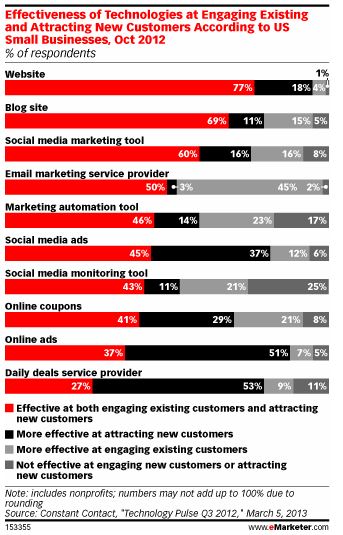
Fortunately enough, CEOs are starting to see the big picture. In a recent eMarketerarticle, blogging was listed as the second most effective tactic small businesses use to engage existing consumers and attract news ones, only eight percentage points behind websites.


If small businesses, who don’t have as many resources, as many employees, as much money or as much time, realize this, how is every Fortune 500 not following suit?

Blogging doesn't go out and annoy potential customers. Blogging brings those potential customers to your site. If you are able to collect and articulate relevant data and content that your audience cares about, the sales will certainly follow.

So go out and start writing, no matter what industry you are in. 

Thursday, April 4, 2013

Don’t be Afraid to Ask the Tough Questions

As a content editor and curator, I get the privilege of talking to some of the brightest minds in the marketing industry. Afterwards, I get to put their words together into a thoughtful, and hopefully, educating story. This is by none by favorite part of my job and why I love what I do.

Last week, I was interviewing an upper-level marketer from 22squared, an agency out of Atlanta. Like any other interview, I prepared my questions beforehand. One that I was nervous to ask dealt with whether or not social media advertising is really worth it or if marketers just spend the money so they don’t lose their budget the following year. Keep in mind, social media advertising is a large portion of this man’s job, so I was somewhat stepping on his toes.

Nonetheless, as any good journalist will tell you, to get good answers, you need to ask good questions. This, my friends, was a good question and you know what; I got a good answer.

His response was, “not only can I tell you that it is worth it, but I can tell you exactly who is seeing your ad and who is not seeing your ad. Anyone who challenges me or asks what my ROI is, I say bring it.”

In the journalism world, that statement is quotable. He not only accepted the question, but was thrilled I asked it. It shows I am not afraid to challenge the status quo, even in an industry that shines on consistency, and my interview rewarded me with a personal answer.

Like any interview, the objective is to first teach your fans something new and second to shine a light into the mind of your respondent. Asking tough questions gives your readers an even closer look into interviewee’s head. This tactic could be questionable in some industries, but when it comes to marketing, the payout if well worth the investment.